Water & fountains · Water structures at and below the courtyard
Cisterns, Wells & Pools
الصهاريج والآبار والبرك
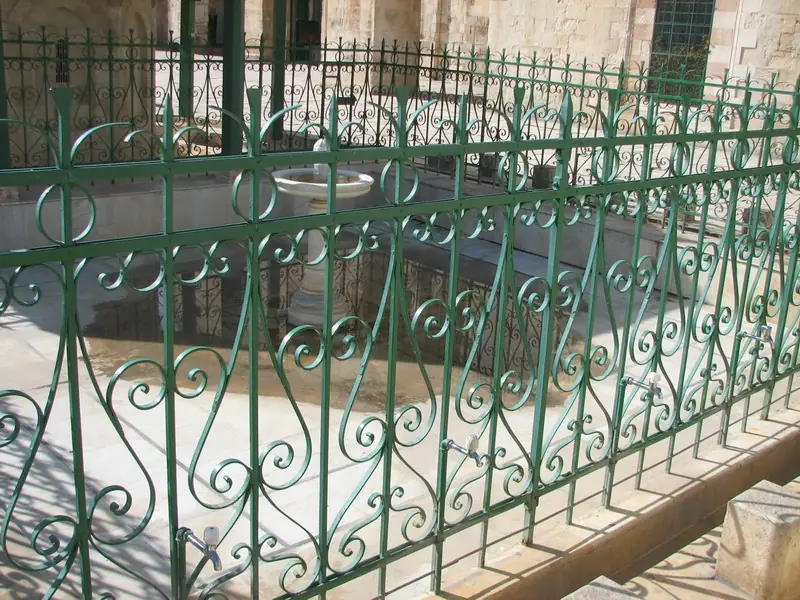
The Naranj Pool, one of the visible water-storage features; the Qasim Pasha Sabil is behind it.Photograph · 2008-02-06 11:03:04
Dr. Abdullah Marouf·CC BY 3.0· Resized and converted to WebP for the web; cropped in cards. Original image license retained.
Overview
A guide to stored water beneath the sanctuary and the visible structures associated with it. [1]
The visible fountains are only part of Al-Aqsa’s water architecture. Lower chambers and wells occupy the space beneath the terraces, while pools and well-heads mark parts of that system at the surface. [1]
The named entries below identify separate structures. Their grouping explains a shared function; it does not assert that every cistern is connected, or that a historical water point is operating or potable today. [2][3]
Details & spaces
Explore the named elements associated with this place.
Cistern of Al-Muazzam Isa
صهريج الملك عيسى المعظم
Also named for Muhammad ibn Urwa al-Mawsili, this Ayyubid water structure lies south of the western platform arcade. Awqaf describes three lower vaulted spaces, one extending beneath the terrace. [2]
Narenj Pool
بركة النارنج
The pool is recorded as a distinct water feature beside the western side of the raised platform in the custodial guide. [5]
Ghawanima Well
بئر الغوانمة
A small circular well east of the Ghawanima Minaret, identified in the Awqaf inventory. [3]
Asbat Minaret Well
بئر مئذنة باب الأسباط
A well immediately south of the Asbat Minaret, separately identified by Awqaf. [4]
PASSIA · Jerusalem Awqaf · Hashemite Fund · Printed pp. 54–65; map legend on PDF page 35
Consulted 2026-10-13
Custodial guide from an Islamic perspective. Used for the baseline inventory and schematic relative positions; its access descriptions are historical, not live advice.
About this record
Relative positions are illustrative; this is a heritage atlas, not a walking route or live access map.
Distributed water structures are represented as a family in the list. No single pin or speculative underground network is presented as a survey. Individual wells beyond these named examples require their own surveyed catalogue.