Understand Al-Aqsa.
Explore the sanctuary through its places, history and religious significance.
Guides, questions, places, timeline & glossary

Common questions
All answersThe knowledge collection
Al-Aqsa basics
The place, its names and the essential distinctions.
What is Al-Aqsa?
Begin with the sanctuary, its main buildings, and the distinction that makes the rest of Al-Aqsa easier to understand.
Al-Aqsa’s names, explained
Al-Masjid al-Aqsa, Al-Haram al-Sharif, Al-Qibli and Qubbat al-Sakhra: how to read names without confusing the places.
The compound: boundaries, size and levels
Understand the enclosure, the approximately 144,000-square-metre area, and the difference between a sanctuary plan and a building footprint.
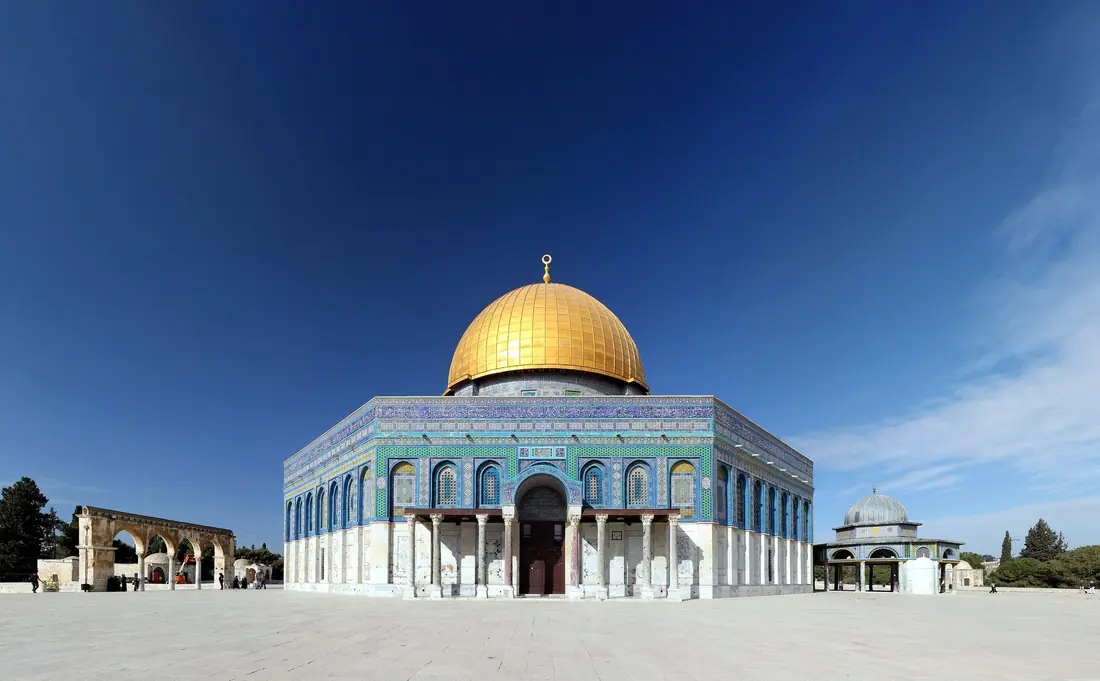
The golden dome and the southern mosque
A clear comparison of the Dome of the Rock, Al-Qibli Mosque and the Al-Aqsa sanctuary that contains them both.
How to read dates and sources
A practical guide to construction dates, inscriptions, competing accounts and the evidence behind this knowledge base.
Places & architecture
Buildings, open spaces and the details between them.
Al-Qibli Mosque: the southern prayer hall
Read the plan, changing fabric and layered history of Al-Aqsa’s principal covered congregational prayer hall.
Dome of the Rock: form, meaning and change
The octagonal monument, its Umayyad foundation, decoration and later layers of restoration.
Dome of the Chain: a small building with open questions
Read its open form, its relationship to the Dome of the Rock, and the limits of explanations for its original purpose.
Reading Al-Aqsa’s smaller domes
Learn to distinguish the Ascension, Prophet and Yusuf domes, and to separate commemorative names from construction dates.
The gates: names, numbers and connections
Understand the sanctuary’s perimeter gates, the familiar count of fifteen, and why an architectural inventory is not live access advice.
Al-Aqsa’s four minarets
Recognize the sanctuary’s minarets, their different profiles, and an unresolved conflict in the published date of Ghawanima.
Water, fountains and ablution
Distinguish a sabil, an ablution fountain and the water infrastructure beneath the sanctuary.
Courtyards, platforms and arcades
Read the open spaces and connecting structures that give the sanctuary its shape.
Madrasas and the architecture of learning
How educational foundations relate to the sanctuary, its edges and the wider intellectual life of Al-Quds.
Al-Ashrafiyya: a Mamluk educational foundation
Study Qaytbay’s madrasa through its entrance, plan, inscription and surviving museum objects.
Materials, decoration and inscriptions
A closer way to look at stone, mosaics, tiles, woodwork and the evidence carried by inscriptions.
Prayer halls, niches and open prayer spaces
Understand Al-Qibli, the Marwani prayer hall, mihrabs, minbars and the sanctuary’s open ground.
History
Patrons, building phases and the work of conservation.
Al-Aqsa and early Islamic Al-Quds
Place the early Muslim sanctuary within the longer sacred history of Al-Quds, without confusing traditions of origin with surviving buildings.
The Umayyad building programme
Abd al-Malik, al-Walid and the development of Al-Aqsa’s best-known monuments.
Abbasid and Fatimid rebuilding
Why the early history of Al-Qibli cannot be read as a single building surviving untouched.
Crusader uses and Ayyubid renewal
Changing uses of the major buildings, Saladin’s recovery of Al-Quds and the return of the Nur al-Din minbar.
Mamluk Al-Quds: schools, water and gateways
See the Mamluk contribution through institutions and the sanctuary’s edges as well as individual monuments.
Ottoman renewal and the visible sanctuary
Tilework, small monuments and later repairs that help explain what visitors see today.
Restoration: how Al-Aqsa’s fabric survives
Understand rebuilding, repair and conservation through documented examples rather than treating every visible surface as original.
Nur al-Din’s minbar: makers, movement and memory
The pulpit commissioned in Aleppo, installed under Saladin and known today through surviving fragments and documentation.
Islamic significance
Religious texts, traditions and their relationship to place.
Why Al-Aqsa matters in Islam
The Night Journey, first qibla and three-mosque tradition, with direct links to the religious texts.
Al-Aqsa and the first qibla
What qibla means, what the sources say about Al-Quds, and what changed when prayer turned toward Mecca.
Isra and Miʿraj: text, tradition and place
Distinguish the Night Journey from the Ascension and the religious accounts from later commemorative buildings.
Tradition, history and claims of origin
How to answer questions about Al-Aqsa’s origins without treating every kind of evidence as interchangeable.
Understanding a visit
Learn to look closely and read the sanctuary.
What you see in the sanctuary
An educational orientation to the buildings, courtyards and details of Al-Aqsa, with clear limits on what old guides can tell a visitor.
The Islamic Museum and the evidence it preserves
Objects, manuscripts and architectural fragments connect the sanctuary’s buildings with a wider material history.
An English collection with source-linked introductions. Historical uncertainties and religious traditions are identified in the text. Read how we work.